

O-Level Physics rewards students who understand how ideas connect, not those who memorise the most. That single difference explains why some students plateau at a B3 no matter how many papers they grind, while others move up to an A1 after they change how they study. This guide covers what the subject includes, how it is marked, how to study it properly, and where most students lose marks. Use it as a map, then follow the links to the deeper guides on each part.
Pure Physics or Combined Science (Physics)?
Before anything else, know which version your child is taking, because the two are different subjects with different depth.
- Pure Physics is a full subject on its own. It covers more topics, goes deeper, and has its own practical component.
- Combined Science (Physics) is half of a Combined Science subject, usually paired with Chemistry. The Physics content is narrower and less detailed.
If your child is still choosing, read our full comparison in Pure Physics vs Combined Science (Physics): which to choose before you decide. The rest of this guide applies to both, with Pure Physics going further in most topics.

What O-Level Physics actually covers
The O-Level Physics syllabus (6091) is organised into six sections. Most exam questions, however hard they look, come back to one of these:
| Theme | What it deals with | Where students struggle |
|---|---|---|
| Measurement | Units, precision, reading instruments | Significant figures, unit conversion |
| Newtonian mechanics | Motion, forces, energy, work, power, pressure | Free-body diagrams, sign conventions |
| Thermal physics | Heat, temperature, the kinetic model, specific heat | Latent heat vs specific heat capacity |
| Waves | General waves, light, the electromagnetic spectrum, sound | Ray diagrams, applying wave equations |
| Electricity and magnetism | Static charge, current, circuits, magnetism, electromagnetism | Series vs parallel, electromagnetic induction |
| Radioactivity | The nuclear atom, types of radiation, radioactive decay, half-life, safety | Balancing nuclear equations, half-life calculations |
Two topics reliably decide grades: mechanics and electricity. They carry a lot of marks and they build on each other, so a weak start in Sec 3 mechanics follows a student all the way to the exam. If that sounds familiar, our tutors explain why Newton’s laws matter in O-Level Pure Physics. For the electricity side, start with three steps to master electromagnetism.
How the exam is marked
O-Level Physics is not one paper. Marks are split across three papers:
| Paper | Type | Duration | Marks | Weighting |
|---|---|---|---|---|
| 1 | Multiple choice | 1 h | 40 | 30% |
| 2 | Structured and free-response questions | 1 h 45 min | 80 | 50% |
| 3 | Practical | 1 h 50 min | 40 | 20% |
The two theory papers carry 80% of the grade, but the practical paper is a full fifth of it.
That 20% matters more than students expect. It tests whether you can take a reading, handle uncertainty, plot a graph and draw a conclusion, and it is hard to fix the week before the exam. If your child has never set up apparatus with their own hands, that is a gap. Our Physics Practical Lab exists for exactly this reason, and we break down the skills in conquering the O-Level Physics practical paper.
A study plan that actually moves grades
Most students study by reading notes and highlighting. That feels productive and changes very little. Here is the sequence our tutors use instead.
1. Understand the concept before the formula. A formula is a shorthand for an idea. If you cannot say in plain words what the idea means, the formula will not save you. This is why memorising fails, as we explain in “Why Memorising Formulas Fails in O-Level Physics.”
2. Build one-page concept summaries, in your own words. Not copied notes. For each topic, write the key ideas, the formulas, the definitions you must recall, and the common traps. The act of compressing a topic to one page is where the learning happens. You can start from our free O-Level Physics notes and resources.
3. Practise by topic, then by paper. Drill one topic until you stop making the same mistake, then move to mixed papers to build exam stamina. Marking your own work against the mark scheme teaches you how examiners award marks, which is a skill of its own.
4. Keep an error log. Every time you lose a mark, write down why: concept gap, careless slip, or misread question. After a few weeks, the pattern is obvious, and you fix the cause instead of redoing random papers.
5. Rehearse the practical with real apparatus. Reading about experiments is not the same as doing them.
Where marks are lost (and how to stop)
Careless mistakes are rarely random. They usually come from a shaky method, which is why we call them systematic in why careless mistakes are actually systematic failures. The common ones:
- Dropping units or using the wrong one. Convert to SI early and keep units through the working.
- Skipping the free-body diagram. Most dynamics mistakes start here. Draw forces first, solve second.
- Confusing series and parallel in circuits, then applying the wrong rule.
- Answering a different question than the one asked. “Explain” wants reasoning. “State” wants a fact. “Calculate” wants working and a unit.
- Rounding too early. Carry extra figures and round only at the end.
What the 2027 SEC framework changes
From 2027, Singapore moves to the Singapore-Cambridge Secondary Education Certificate, with subjects taken at different levels under full Subject-Based Banding. Physics at the G3 level maps to the familiar O-Level standard.
For most families, the content of Physics does not change overnight, but the way subjects are counted for the next stage does. We cover that in how O-Level points are counted, the 2027 changes, and for current Sec 2 students we explain the transition from Sec 2 to Sec 3 Physics: avoiding a six-month lag.
How MindQuest teaches Physics
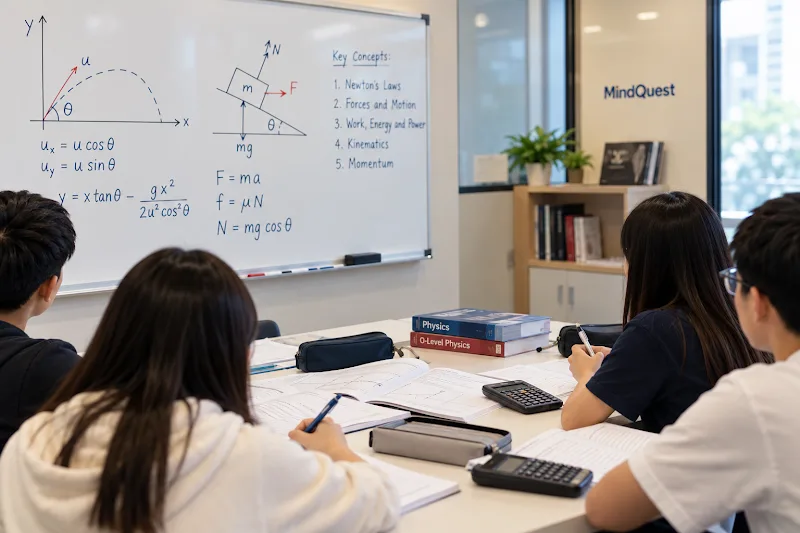
We run a five-step Blueprint for every topic: concept, worked example, guided practice, independent practice, then exam technique. Lessons happen in small classes at our Jurong East and Eunos centres, with a dedicated Physics Practical Lab for the hands-on paper. Students who need fully personalised help can take private one-to-one Physics tuition led by an ex-MOE JC lecturer.
The simplest way to see if it fits your child is to sit in. Book a free trial lesson and watch how a topic is taught before you decide.
Frequently asked questions
How many topics are there in O-Level Physics? The syllabus is grouped into five broad themes: measurement, mechanics, thermal physics, waves, and electricity and magnetism. Mechanics and electricity carry the most marks.
Is O-Level Physics hard? It is demanding because it builds on itself, so gaps compound. Students who understand the concepts and practise by topic usually find it manageable. Rote memorising is what makes it feel impossible.
How do I study for O-Level Physics effectively? Understand each concept first, write your own one-page summaries, practise by topic then by full paper, keep an error log, and rehearse the practical with real apparatus.
Does the practical paper really matter? Yes. It carries a meaningful share of the grade and tests skills you cannot cram, such as taking readings, handling uncertainty and plotting graphs.