

Many students who consistently score A1 or A2 in Secondary 2 Science experience an unexpected grade dip in their first Secondary 3 Pure Physics Weighted Assessment. This sudden drop causes unnecessary panic for both parents and students.
This gap occurs because Lower Secondary Science rewards broad content recall, whereas Upper Secondary Physics demands mathematical modeling and vector analysis from day one.
Sec 2 General Science vs. Sec 3 Pure Physics (Syllabus 6091)
| Lower Sec 2 General Science | Upper Sec 3 G3 Physics | |
|---|---|---|
| Question | "Define speed and state its standard SI unit." | "A 1000 kg car accelerates uniformly from rest for 6 s to reach 15 m/s, then travels at constant velocity for 10 s before braking to a stop over 30 m. Calculate the braking force." |
| Focus | Memorizing definitions and applying simple single-variable formulas (d = v x t). | Multi-stage motion analysis, extracting displacement from velocity-time graphs, and applying net force equations (Fnet = ma). |
The Structural Trap: How Newtonian Mechanics Cascades
Upper Secondary Physics begins with Section II of the syllabus: Newtonian Mechanics. Unlike lower secondary topics which are often taught in isolation, Newtonian mechanics concepts are strictly cumulative. Failing to understand chapter one guarantees failure in chapter three.
Topic 1 & 2 (Measurement & Kinematics): Students learn scalar and vector quantities, displacement-time graphs, velocity-time graphs, and uniform acceleration (a = (v-u) / t).
Topic 3 (Dynamics): Kinematics directly feeds into Newton’s Laws of Motion, free-body diagrams, friction, and calculating resultant force (Fnet = ma). Weak vector logic in Kinematics leads to errors when resolving forces in Dynamics.
Topics 4 & 5 (Turning Effect of Forces & Pressure): Moment calculations (M = F x d) and liquid pressure depend entirely on a clear understanding of vector forces and equilibrium.
The Real Risk of Delaying Action
When foundational gaps are left unaddressed in Term 1, the academic workload compounds quickly. Here is what the typical 6-month lag looks like for a struggling student.
Term 1 (Jan–Mar): Students attempt to memorize Kinematics and Dynamics formulas without mastering vector resolution or graph slopes, leading to lost marks in WA1.
Term 2 (Apr–Jun): Teachers move into the Turning Effect of Forces, Pressure, and Energy. Because these topics build directly on force vectors and work done (W = F x d), early misunderstandings multiply.
Mid-Year Backlog: Parents often wait for May WA2 results before seeking help. By June, the student must remediate four interconnected mechanics topics while keeping up with Thermal Physics in Term 3. Unlearning bad problem-solving habits under time constraints creates unnecessary stress.
Core Skills to Build Before Secondary 3
Incoming Sec 3 students benefit significantly from mastering three foundational shifts before the new school term starts. Understanding the specific challenges of transitioning to Upper Secondary Physics allows parents to implement structured support before the academic workload compounds.
Vector Operations: Distinguishing scalar quantities (distance, speed) from vector quantities (displacement, velocity, force).
Graphical Calculus: Reading physical quantities directly from gradients (acceleration) and areas under velocity-time curves (displacement).
SEAB Answering Precision: Learning the exact scientific terminology required by markers instead of using conversational descriptions.
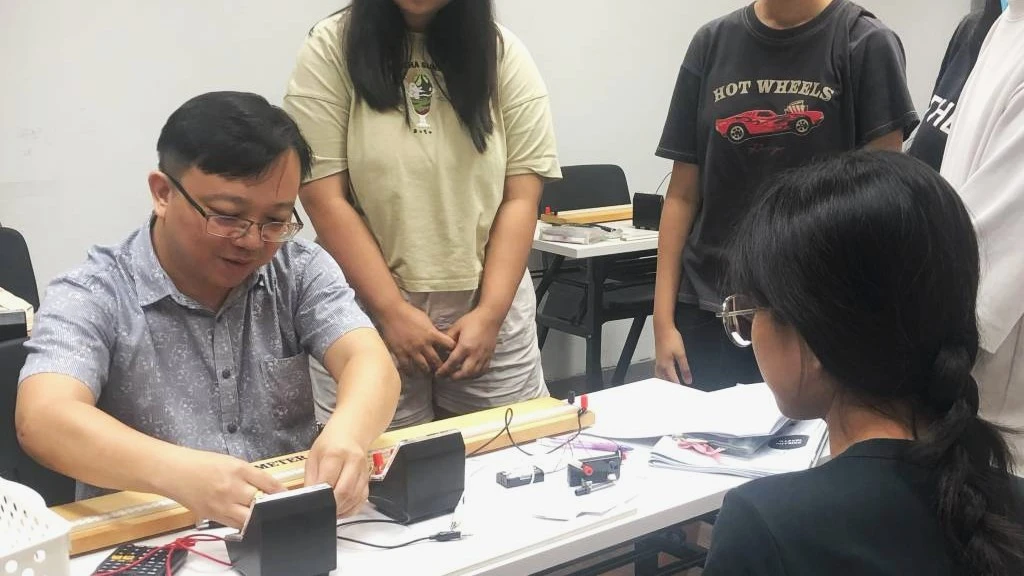
Secure the Foundation Early: Sec 2 to Sec 3 Bridging Workshop
You do not have to wait for the mid-year academic shock. Preparing early allows students to build the necessary algebraic and logical frameworks before the school year begins.
Our year-end MindQuest Bridging Workshop equips incoming Sec 3 students with the mathematical and graphical tools required for G3 Physics (Syllabus 6091). Led by experienced ex-MOE physics specialists, we focus on problem-solving logic and introduce students to the rigor of O-Level expectations. This ensures they enter Secondary 3 already ahead of the curve.
Contact us today to secure a spot for your child and eliminate the Sec 3 physics lag before it begins.