
O-Level Physics 2026 Paper 1 Answers (6091/01)
Full answer key and step-by-step worked solutions by Mr Lai · October/November 2026 · all 40 questions
Save or share as PDF WhatsApp +65 8758 4968Answer key
Tap any number to jump to its full solution.
Answers checked by Mr Lai. The official answer key has not been released yet.
Full worked solutions
A runner covers 100 m in three stages (5.0 m in 1.0 s, 90 m in 12 s, 5.0 m in 1.1 s). Find the average speed.
Answer: C
Average speed is total distance ÷ total time for the whole journey.
total distance = 5.0 + 90 + 5.0 = 100 m
total time = 1.0 + 12 + 1.1 = 14.1 s
average speed = 100 ÷ 14.1 = 7.09 m/s ≈ 7.1 m/s
Why not the other options
- A (0.14 m/s): time ÷ distance, upside down (14.1 ÷ 100).
- B (5.7 m/s): the mean of the three stage speeds (5.0, 7.5 and 4.5 m/s) — not allowed.
- D (17 m/s): the three stage speeds added together.
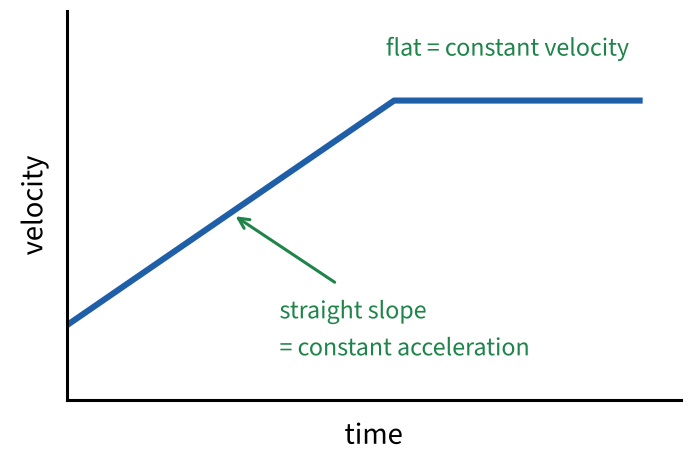
Which graph shows constant acceleration followed by constant velocity?
Answer: B
Read the y-axis label first. On a velocity–time graph, the gradient is the acceleration.
Graph B is a velocity–time graph. Its first part is a straight sloping line, so the gradient is constant: constant acceleration.
Its second part is horizontal, so velocity no longer changes: constant velocity.
Why not the other options
- A: displacement–time graph — constant velocity, then at rest.
- C: displacement–time curve that levels off — slowing down to rest.
- D: velocity–time curve with a decreasing gradient — acceleration decreasing, never constant.
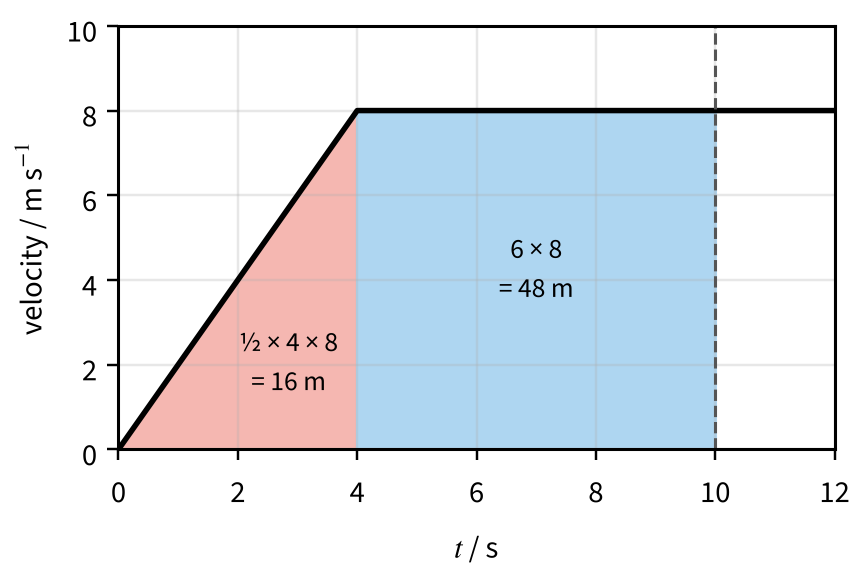
Find the total distance travelled from t = 0 to t = 10 s from the velocity–time graph.
Answer: B
Distance travelled = area under the velocity–time graph. Split the area into simple shapes up to t = 10 s only.
triangle (0 to 4 s) = ½ × 4 × 8 = 16 m
rectangle (4 to 10 s) = 6 × 8 = 48 m
total distance = 16 + 48 = 64 m
Why not the other options
- A (48 m): only the rectangle; the triangle is missed.
- C (80 m): 8 × 10, as if the object moved at 8 m/s from the start.
- D (96 m): 8 × 12, the whole graph to 12 s at the top speed.
An object of mass 500 g, with g = 10 m/s². Find its weight.
Answer: B
Convert the mass to kilograms first: 500 g = 0.500 kg.
W = mg = 0.500 × 10 = 5.0 N
Why not the other options
- A (0.050 N): 0.500 ÷ 10, divided instead of multiplied.
- C (50 N): 500 ÷ 10 — no kg conversion and g divided instead of multiplied.
- D (5000 N): used 500 g as 500 kg.
A car rolls down a slope at constant speed. Which statement about the resultant force is correct?
Answer: D
The car moves in a straight line at constant speed, so its velocity is constant and its acceleration is zero.
F = ma = m × 0 = 0
So the resultant force is zero. The component of weight down the slope is exactly balanced by friction (and air resistance) up the slope.
Why not the other options
- A: “weight minus friction” would be non-zero and would make the car speed up. Also, only the component of weight along the slope matters.
- B and C: either would give the car an acceleration, so its speed would change.
Piston X has a smaller area than piston Y. Which statement is correct?
Answer: A
The liquid is incompressible, so pressure applied at X is transmitted equally throughout the fluid. Pressure on Y = pressure on X.
F = pA
With the same pressure, the piston with the larger area gets the larger force. AY > AX, so a downward force on X causes a larger force on Y.
Why not the other options
- B: force on Y is larger, not smaller.
- C and D: the pressure is the same on X and Y.
A 1.0 g hollow ball (external volume 4.0 cm³) is injected with liquid until its overall density is 1.5 g/cm³. Find the mass of liquid.
Answer: C
The external volume does not change, so use it with the new density.
new total mass = ρV = 1.5 × 4.0 = 6.0 g
mass of liquid = 6.0 − 1.0 = 5.0 g
Why not the other options
- D (6.0 g): forgot to subtract the 1.0 g of plastic.
- A (1.7 g): divided volume by density (4.0 ÷ 1.5 = 2.7) and then took away 1.0.
- B (3.0 g): does not give 1.5 g/cm³ for a 4.0 cm³ ball.
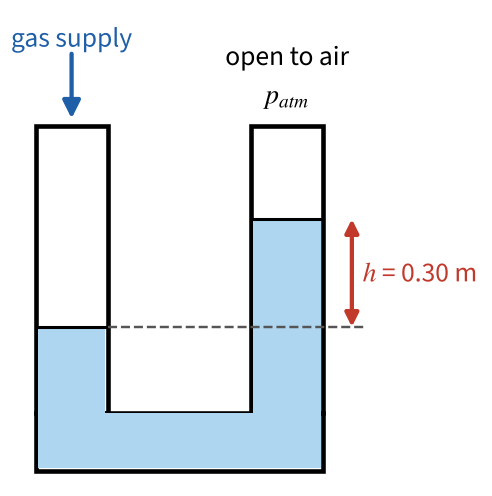
A water manometer is connected to a gas supply. The water on the gas side is 0.30 m lower than on the open side. Atmospheric pressure is 100 000 Pa. Find the gas pressure.
Answer: B
The gas pushes its side of the water down, so the gas pressure is greater than atmospheric pressure by hρg.
hρg = 0.30 × 1000 × 10 = 3000 Pa
pgas = patm + hρg = 100 000 + 3000 = 103 000 Pa = 1.03 × 10⁵ Pa
Why not the other options
- A (3.00 × 10³ Pa): only the extra pressure hρg; atmospheric pressure is left out.
- C and D: power-of-ten errors.
Which property measures the inertia of an object?
Answer: B
Inertia is the reluctance of an object to change its state of rest or motion.
The larger the mass, the harder it is to start, stop or change its motion. So mass is the measure of inertia.
Why not the other options
- A and C: density and volume do not decide how hard an object is to accelerate.
- D: weight depends on the gravitational field strength, so it changes with location; inertia does not.
P has mass m and kinetic energy 2E. Q has mass 2m and kinetic energy E. Compare their speeds.
Answer: C
Rearrange the kinetic energy formula for speed:
Ek = ½mv² so v² = 2Ek ÷ m
P: vP² = 2(2E) ÷ m = 4E ÷ m
Q: vQ² = 2E ÷ 2m = E ÷ m
vP² ÷ vQ² = 4, so vP ÷ vQ = √4 = 2
The speed of P is twice the speed of Q.
Why not the other options
- D (four times): forgot the square root.
- A and B: kinetic energy ratio or mass ratio used without the formula.
Which two quantities alone are needed to calculate the power developed by a force?
Answer: D
Power is the rate of doing work:
P = W ÷ t (work done ÷ time taken)
So you need the work done by the force and the time taken.
Why not the other options
- A: force × distance gives work done only; no time.
- B: force and time alone — no distance, so the work done is unknown.
- C: no time.
A motor (input power 200 W, efficiency 15%) lifts a 50 kg box through 6.0 m. Find the time taken (g = 10 N/kg).
Answer: D
Useful energy gained by the box:
Ep = mgh = 50 × 10 × 6.0 = 3000 J
Useful output power of the motor:
useful power = 0.15 × 200 = 30 W
t = energy ÷ power = 3000 ÷ 30 = 100 s
Check another way: input energy = 3000 ÷ 0.15 = 20 000 J, and 20 000 ÷ 200 = 100 s.
Why not the other options
- B (15 s): 3000 ÷ 200, efficiency ignored.
- A and C: efficiency applied wrongly.
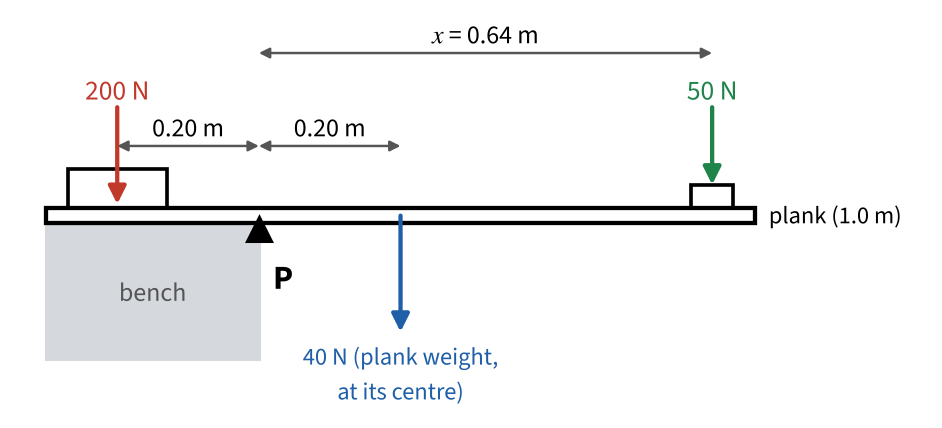
A 1.0 m uniform plank (40 N) rests on a bench edge P, 0.30 m from its left end. A 200 N block acts 0.20 m left of P. Find the maximum distance x of a 50 N block to the right of P before the plank rotates about P.
Answer: C
At the maximum x, the plank is just about to tip about P (the bench pushes only at P). Take moments about P.
The plank is uniform, so its weight acts at its centre: 0.50 m from the left end, which is 0.50 − 0.30 = 0.20 m to the right of P.
anticlockwise moment = 200 × 0.20 = 40 N m
clockwise moment = 40 × 0.20 + 50 × x = 8 + 50x
Principle of moments: 40 = 8 + 50x so x = 32 ÷ 50 = 0.64 m
Check: 0.64 m is less than 0.70 m (the plank’s right end), so the block can sit there.
Why not the other options
- D (0.80 m): the plank’s own weight was left out (40 ÷ 50).
- B (0.56 m): plank weight taken 0.30 m from P.
- A (0.40 m): plank weight taken 0.50 m from P (that is its distance from the left end, not from P).
Which change makes the standing student more stable?
Answer: C
An object is more stable when its centre of gravity is lower and/or its base is wider.
Squatting with the body upright lowers the centre of gravity, while it still stays above the base. He must tilt through a bigger angle before the line of action of his weight falls outside the base.
Why not the other options
- A: heavy books high on his back raise the centre of gravity and shift it backwards — less stable.
- B: raising the arms raises the centre of gravity — less stable.
- D: feet together makes the base narrower — less stable.
More air is pumped into the sealed smoke box at the same temperature. What changes?
Answer: C
The specks move randomly because air molecules collide with the smoke particles unevenly from all sides.
More air at the same volume means more air molecules per unit volume. The smoke particles are hit more frequently, so they change direction more often and travel a shorter distance between changes.
The temperature is unchanged, so the average kinetic energy (and speed) of the air molecules is unchanged.
Why not the other options
- A: the number of smoke particles is constant, so the number of specks seen is the same.
- B: faster movement needs a higher temperature, which did not happen.
- D: the motion does change — the path becomes more jagged.
Which statement about changes of state is correct?
Answer: A
When a liquid solidifies, the particles form bonds and release latent heat to the surroundings. So energy is transferred from the liquid. A is correct.
Why not the other options
- B: condensation and solidification give out energy, so not “all”.
- C: evaporation happens at any temperature, from the surface.
- D: while boiling, the temperature stays constant at the boiling point; the energy goes into breaking bonds.
At constant temperature, a gas is compressed and its pressure rises. Why?
Answer: B
Temperature is constant, so the molecules move with the same average speed.
A smaller volume means more molecules per unit volume, so molecules collide with the walls more frequently.
There is a greater force per unit area on the walls, so the pressure increases.
Why not the other options
- A: collisions between molecules do not push on the walls.
- C and D: the molecules do not move faster — the temperature is constant.
Which processes describe conduction in a metal?
Answer: B
Statement 1 is correct: at the hot end, ions vibrate more and collide with neighbouring ions, passing energy along the lattice.
Statement 2 is correct: free electrons gain kinetic energy, move to colder regions and collide with ions there. This is why metals conduct so well.
Statement 3 is wrong: ions in a solid stay in fixed positions. Movement of the material itself is convection, which only happens in fluids.
Why not the other options
- A, C, D: all include statement 3, which is wrong.
Which energy resource releases carbon dioxide when generating electricity?
Answer: A
Fossil fuels (coal, oil, natural gas) are burned. Combustion of carbon-based fuel produces carbon dioxide.
Why not the other options
- B (geothermal): uses heat from hot rocks.
- C (hydroelectric): uses gravitational potential energy of water.
- D (nuclear): uses nuclear fission; no burning, no CO2 during generation.
Which process increases the internal energy of the substance named?
Answer: D
Internal energy is the total kinetic and potential energy of the particles. It increases when energy is transferred into the substance.
An electric heater transfers energy into the water, so its particles gain kinetic energy and the water’s internal energy increases.
Why not the other options
- A: condensing vapour gives out latent heat — internal energy decreases.
- B: the air is cooled — energy is removed.
- C: the most energetic molecules escape, so the remaining water cools; with insulation no energy comes in, so its internal energy decreases.
H2 Physics jumps fast in JC1. Start strong with Mr Lai. 2027 classes are open for registration. WhatsApp +65 8758 4968
A bar vibrates 30 times per minute; the wave speed is 4.0 cm/s. Find the wavelength.
Answer: D
Frequency must be per second:
f = 30 ÷ 60 = 0.50 Hz
λ = v ÷ f = 4.0 ÷ 0.50 = 8.0 cm
Why not the other options
- A (0.13 cm): used f = 30 Hz.
- B (0.50 cm): the frequency, not the wavelength.
- C (2.0 cm): multiplied v × f instead of dividing.
Which statement about longitudinal and transverse waves is correct?
Answer: B
All waves transfer energy without transferring matter. The particles only oscillate about fixed positions.
Why not the other options
- A: both types refract.
- C: sound (longitudinal) cannot travel in a vacuum at all.
- D: both types can travel in water (sound travels in water too).
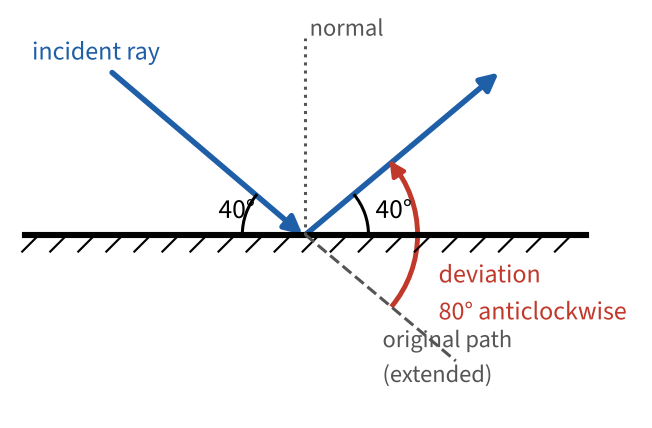
A ray strikes a plane mirror at 40° to the mirror surface. Through which angle, and in which sense, is it deviated?
Answer: A
The 40° is measured from the mirror, not the normal. So the angle of incidence is 90° − 40° = 50°, and the angle of reflection is also 50°. The reflected ray also leaves at 40° to the mirror.
Deviation is the angle between the original direction of travel (extended) and the new direction.
deviation = 180° − (i + r) = 180° − 100° = 80° (= 2 × 40°)
The ray was travelling down to the right and now travels up to the right. It has turned anticlockwise.
Why not the other options
- B: correct size, wrong sense — the ray turns anticlockwise in this diagram.
- C and D (100°): this is i + r, the angle between the two rays, not the deviation.
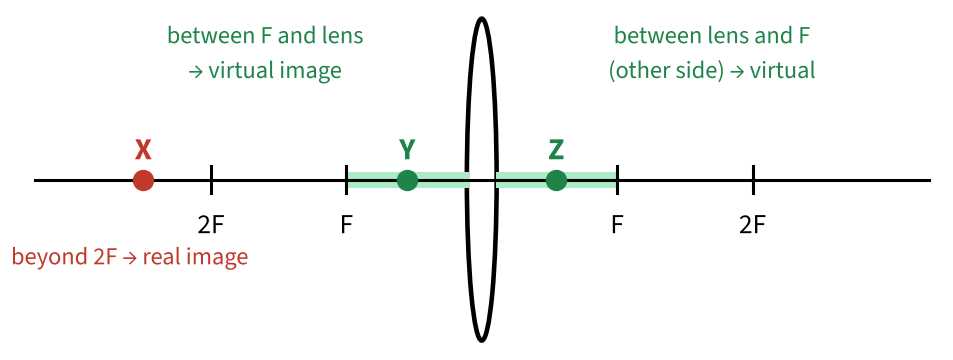
An object is placed at X (beyond 2F), Y (between F and the lens) and Z (on the other side, between the lens and F). Where is the image virtual?
Answer: C
A converging lens forms a virtual image only when the object is between the lens and the focal point (object distance < f).
X is beyond 2f: the image is real, inverted and diminished.
Y is between F and the lens: virtual image (magnifying glass).
Z is less than f from the lens on the other side. A lens has a focal point on both sides, so an object at Z also gives a virtual image.
Why not the other options
- A and B: X gives a real image.
- D: misses Z — Z is also within one focal length of the lens.
A bat hears the echo of its pulse 0.064 s after sending it. Sound travels at 0.34 km/s. How far is the wall?
Answer: A
Convert: 0.34 km/s = 340 m/s. The pulse travels to the wall and back, so the total distance is 2d.
2d = vt = 340 × 0.064 = 21.76 m
d = 21.76 ÷ 2 = 10.9 m ≈ 11 m
Why not the other options
- B (22 m): forgot to halve — this is the there-and-back distance.
- C and D: divided speed by time instead of multiplying (0.34 ÷ 0.064 = 5.3 km; halved gives 2.7 km).
Why is ultrasound, not X-rays, used to scan an unborn baby?
Answer: A
X-rays are ionising: they can damage or kill living cells and harm the developing baby. Ultrasound does not cause ionisation, so it is safe.
Why not the other options
- B: true, but the wave type has nothing to do with safety.
- C: false — both need a machine to detect them.
- D: true, but speed is not why X-rays are avoided.
Which component can damage human skin cells by ionisation?
Answer: D
Ultraviolet has the highest frequency of the four options. It is ionising and damages skin cells (sunburn, skin cancer).
Why not the other options
- A, B, C: infrared, visible light and microwaves have lower frequencies and are non-ionising (infrared and microwaves can heat tissue, but do not ionise).
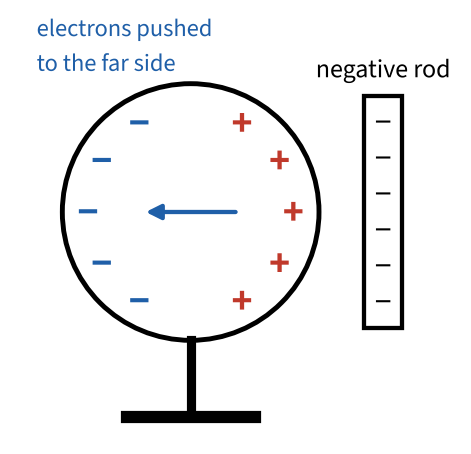
A negatively charged rod is brought near an uncharged metal sphere on an insulated stand. Which diagram shows the charges?
Answer: C
The free electrons in the metal are repelled by the negative rod and move to the far side of the sphere.
The near side is left with a shortage of electrons, so it is positive.
The sphere is insulated, so no charge enters or leaves: the sphere is still neutral overall, with equal amounts of + and −. Only diagram C shows this.
Why not the other options
- A: shows only + charge, so the sphere would be charged overall.
- B: negative charge near a negative rod — like charges repel, so this is wrong.
- D: charges the wrong way round.
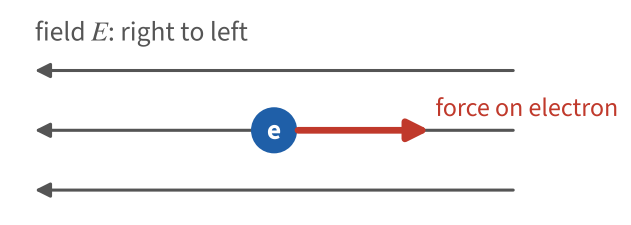
What is the direction of the electric field that pushes a stationary electron to the right?
Answer: D
The direction of an electric field is the direction of the force on a positive charge.
An electron is negative, so the force on it is opposite to the field. Force to the right means the field points from right to left.
Why not the other options
- A and B: a field into or out of the paper gives a force into or out of the paper, not to the right.
- C: this is the direction of the force on a positive charge.
What is the definition of p.d. across a component?
Answer: C
Potential difference is the work done to drive unit charge through the component:
V = W ÷ Q
Why not the other options
- A: rate of doing work is power.
- B: rate of flow of charge is current.
- D: work per unit current has no meaning here.
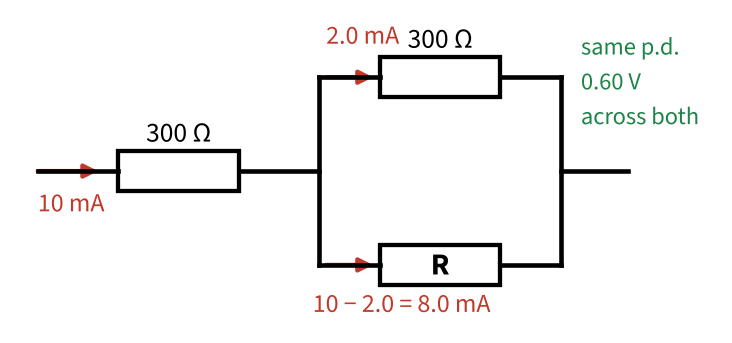
10 mA enters a parallel pair: 2.0 mA flows through 300 Ω, the rest through R. Find R.
Answer: C
Current splits at the junction: the current in R = 10 − 2.0 = 8.0 mA.
Parallel branches have the same p.d.:
V = IR = 2.0 × 10−3 × 300 = 0.60 V
R = V ÷ I = 0.60 ÷ (8.0 × 10⁻³) = 75 Ω
The first 300 Ω resistor is in series before the junction; it does not affect this calculation.
Why not the other options
- B (60 Ω): used the total 10 mA instead of 8.0 mA.
- D (1500 Ω): scaled the wrong way — the branch with more current must have the smaller resistance.
Which use of appliances costs the most?
Answer: A
Cost depends on energy used: E = Pt (in kW h).
A: 0.250 kW × 2.5 h = 0.625 kW h
B: 6 × 0.010 kW × 8.0 h = 0.48 kW h
C: 2 × 0.090 kW × 3.0 h = 0.54 kW h
D: 2 × 1.6 kW × (10 ÷ 60) h = 0.53 kW h
A uses the most energy, so it costs the most.
Why not the other options
- D is the trap: very high power but only 10 minutes.
Which statements about the wires in a plug on the a.c. mains are correct?
Answer: A
1 is correct: the fuse is in the live wire, so when it blows, the appliance is cut off from the high voltage.
2 is wrong: the switch must also be in the live wire, not the neutral.
3 is correct: the supply is alternating, so the live wire swings positive and negative relative to earth.
4 is wrong: the neutral wire stays at about 0 V; it is never equal to the live wire.
So the answer is 1 and 3.
Why not the other options
- B: statement 4 is wrong — if live and neutral were at the same voltage, no current would flow.
- C and D: statement 2 is wrong.
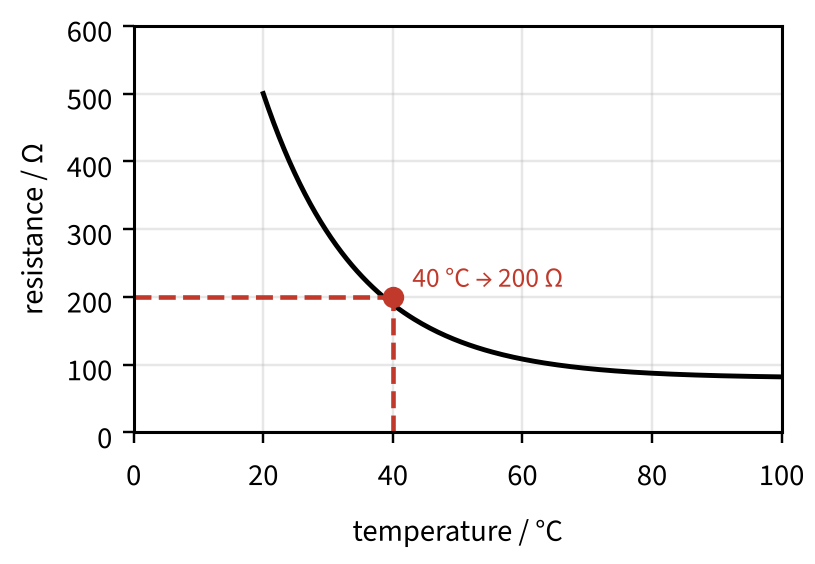
A thermistor and a 100 Ω resistor are in series with 6.0 V. Find the current at 40 °C.
Answer: A
Read the graph: at 40 °C, the thermistor resistance is 200 Ω.
total resistance = 200 + 100 = 300 Ω
I = V ÷ R = 6.0 ÷ 300 = 0.020 A = 20 mA
Why not the other options
- B (30 mA): thermistor alone (6.0 ÷ 200).
- D (60 mA): 100 Ω resistor alone (6.0 ÷ 100).
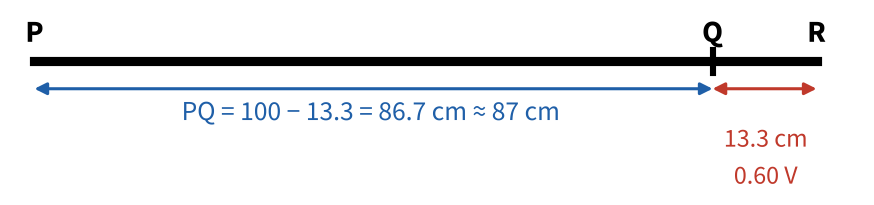
A 4.5 V supply is across a uniform 100 cm wire PR. The p.d. between Q and R is 0.60 V. Find PQ.
Answer: D
For a uniform wire, p.d. is proportional to length.
p.d. per cm = 4.5 ÷ 100 = 0.045 V/cm
QR = 0.60 ÷ 0.045 = 13.3 cm
PQ = 100 − 13.3 = 86.7 cm ≈ 87 cm
Why not the other options
- A (13 cm): this is QR, not PQ.
- B and C: neither length gives 0.60 V across QR on a uniform 4.5 V wire.
Which metal bar would become a permanent magnet in the solenoid?
Answer: D
A permanent magnet must be made of a hard magnetic material, which keeps its magnetism after the current is switched off. Steel is a hard magnetic material.
Why not the other options
- C (iron): a soft magnetic material — magnetised easily but loses its magnetism when the current stops.
- A and B: aluminium and copper are non-magnetic.
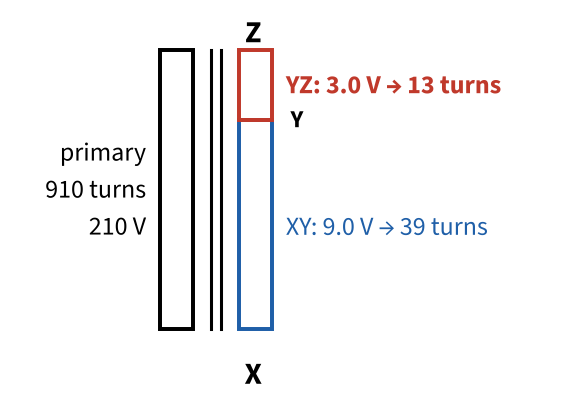
A transformer has 910 primary turns at 210 V. Secondary coils XY and YZ in series give 9.0 V across XY and 12 V across XZ. Find the turns on YZ.
Answer: A
The two secondary coils are in series, so their p.d.s add:
p.d. across YZ = 12 − 9.0 = 3.0 V
Ns ÷ Np = Vs ÷ Vp so NYZ = 910 × 3.0 ÷ 210 = 13 turns
Check: XY = 910 × 9.0 ÷ 210 = 39 turns, XZ = 52 turns, and 39 + 13 = 52.
Why not the other options
- B (39): turns on XY.
- C (52): turns on the whole XZ.
An e.m.f. is induced in a stationary coil by a magnet. Which statements are correct?
Answer: B
1 is correct: the coil is stationary, so the magnet must be moving to change the magnetic flux linkage.
2 is correct: Lenz’s law — the induced e.m.f. opposes the change producing it.
3 is wrong: moving the magnet more slowly gives a smaller rate of change of flux linkage, so a smaller e.m.f.
4 is correct: more turns give a larger change in flux linkage, so a larger e.m.f.
So the answer is 1, 2 and 4.
Why not the other options
- A, C, D: all include statement 3, which is wrong.
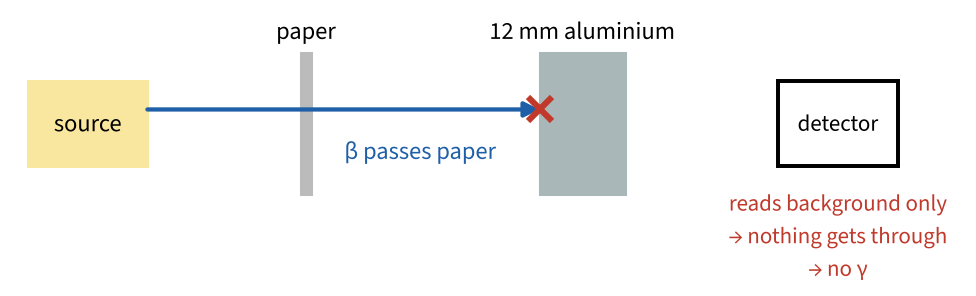
Count rate: background P; with the source, Q. Paper in between: still Q. 12 mm of aluminium: back to P. What does the source emit?
Answer: C
Paper makes no difference, so there is no alpha (alpha would be stopped by paper; at 15 mm in air it would still reach the detector).
12 mm of aluminium brings the count rate down to background, so everything from the source is stopped. Beta is stopped by a few mm of aluminium.
If there were gamma, it would pass through the aluminium and the count rate would stay above background. So there is no gamma. The source emits beta only.
Why not the other options
- A: alpha would be stopped by the paper, but the count did not drop.
- B: gamma would get through the aluminium.
- D: gamma would not be stopped by 12 mm of aluminium.
Half-life 3.0 h. Reading 920 counts/s, then 260 counts/s after 6.0 h. Find the background reading.
Answer: D
Only the count from the source halves; the background stays the same. Let the background be B.
6.0 h = 2 half-lives, so the source count falls to ¼ of its value.
260 − B = ¼ (920 − B)
1040 − 4B = 920 − B so 3B = 120 so B = 40 counts/s
Check: source count = 920 − 40 = 880 → 440 → 220 after 6.0 h; 220 + 40 = 260 ✓
Why not the other options
- C (30 counts/s): halved 920 twice to get 230, then took 260 − 230 — the background was halved along with the source.
Reserve your seat for 2027
Classes now open for registration at Eunos and Jurong East: Sec 3 and Sec 4 O-Level Physics, JC1 and JC2 H2 Physics, and IP Physics. Register for 2027 and receive a complimentary Physics Codex, Mr Lai’s book of the Cambridge keywords you must write word for word to score full marks.
WhatsApp +65 8758 4968 to reserve a seat Save or share as PDF