
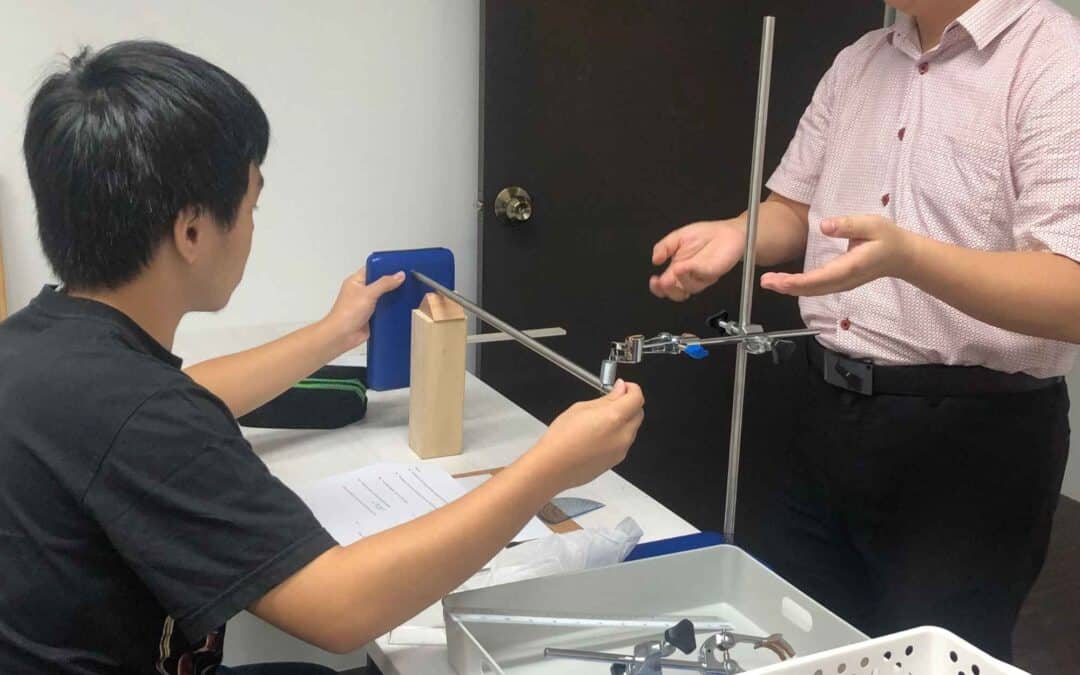
For Secondary 4 students in Singapore, Paper 3 is the ultimate wildcard. Worth a substantial 20 percent of the final O-Level Physics grade, the practical exam tests a completely different skill set from Paper 1 or Paper 2.
Knowing your formulas is not enough. You must demonstrate physical manipulation, precise measurement, and real-time problem-solving under strict Singapore Examinations and Assessment Board (SEAB) marking rubrics.
Here is how you can secure your 20% before you step into the written exams.
What is Tested in the O-Level Physics Practical?
To score a distinction, students must master four core competencies laid out in the MOE syllabus:
Planning: Designing an experiment from scratch. You must clearly identify your independent, dependent, and constant variables alongside necessary safety precautions.
Manipulation and Measurement: Setting up apparatus correctly and recording raw data to the exact precision of the instrument.
Observation: Spotting trends and identifying anomalous outlier data in real-time.
Analysis and Evaluation: Calculating derived values, plotting graphs, and suggesting concrete improvements to the experimental setup.
The Trap of Careless Mistakes in Data Tables
The most common reason students drop grades in Paper 3 is not a lack of conceptual understanding. The root issue is inconsistent data recording. Examiners look for absolute consistency in significant figures (s.f.) and decimal places (d.p.) based on the specific instrument used.
For example, a micrometer screw gauge reading must always be recorded to two decimal places in millimeters (e.g., 2.55 mm). If a student writes 2.5 mm, they immediately lose marks. These intermediate rounding errors compound throughout the experiment, leading to massive mark deductions. We cover this exact phenomenon extensively in our guide on fixing systematic careless mistakes in Physics where we explain how these intermediate rounding errors in data tables lead to severe grade drops.
Pro-Tips for O-Level Physics Practical Success
Depending on the experiment you are assigned, keep these SEAB-approved O Level Physics practical tips Singapore students must know top of mind:
Mechanics (The Oscillation Rule): For pendulum or spring experiments, never take a single reading. Always time at least 20 oscillations, repeat the timing twice (t1, t2), and calculate the average.
Electricity (Check for Zero Errors): Before closing the circuit, check your ammeters and voltmeters. Write down any zero errors explicitly. Always tap the meter gently before reading to ensure the needle isn’t stuck.
Light (The 5 cm Rule): When doing optics experiments with glass blocks and optical pins, ensure your pins are placed at least 5cm apart to minimize angular drawing errors. Always use a sharply pointed pencil.
Graph Plotting & Gradients: Your graph should occupy at least 50% of the grid. Draw a line of best fit that balances the number of points above and below the line. When calculating the gradient, the triangle you draw must cover more than half the length of your line!
Practicing these exact rubrics is how MindQuest students consistently secure their 20% before they even step into the written papers.

Ace Your Practical with MindQuest
Practicing these exact rubrics is how MindQuest students consistently secure high marks in their practicals. Reading about theory is only half the battle. You need hands-on practice with actual lab equipment to build muscle memory and confidence. Secure your final grade with targeted practical preparation under the guidance of our Physics specialists.