

Every H2 Physics student learns early that a Data and Formulae page comes with the exam. Many then make a quiet, costly assumption: that they do not need to memorise formulas any more. They walk into the paper, reach for a relationship that feels like it should be on the sheet, and discover it was never there.
The formula sheet is useful. It is not a safety net. This guide shows what it actually gives you, which formulas you still have to carry in your head, and how to use the sheet so it saves time instead of wasting it.
What the formula sheet gives you
The sheet is a reference for the bulkier, harder-to-recall relationships and the physical data you need, so you are not penalised for forgetting a constant. Broadly, it provides the data (physical constants and values) and a set of standard formulae across the syllabus.
The key point: it is organised for lookup, not for thinking. If you do not already know which formula you need and why, scanning the sheet mid-exam burns time you do not have.
These are the relationships SEAB gives you:
| Topic area | Formulae given |
|---|---|
| Kinematics | s = ut + ½at² and v² = u² + 2as |
| Pressure and gases | p = F/A; work done on/by a gas W = pΔV; p = ⅓(Nm/V)⟨c²⟩; mean translational kinetic energy E = (3/2)kT; T/K = T/°C + 273.15 |
| Gravitation | gravitational potential φ = −GM/r |
| Oscillations | x = x₀ sin ωt; v = v₀ cos ωt = ±ω√(x₀² − x²) |
| Current and circuits | I = nAvq; resistors in series and in parallel; capacitors in series and in parallel |
| Capacitors | energy U = ½QV = ½Q²/C = ½CV²; charging and discharging equations; τ = RC |
| Fields | electric potential V = Q/4πε₀r; B for a long straight wire, a flat circular coil and a long solenoid |
| Alternating current | x = x₀ sin ωt |
| Modern physics | particle in a box Eₙ = h²n²/8mL²; radioactive decay x = x₀e^(−λt); λ = ln 2 / t½ |
Notice what that means. The suvat equations, the resistor combination rules and p = F/A are all given. Students who spend hours memorising those are spending effort in the wrong place.
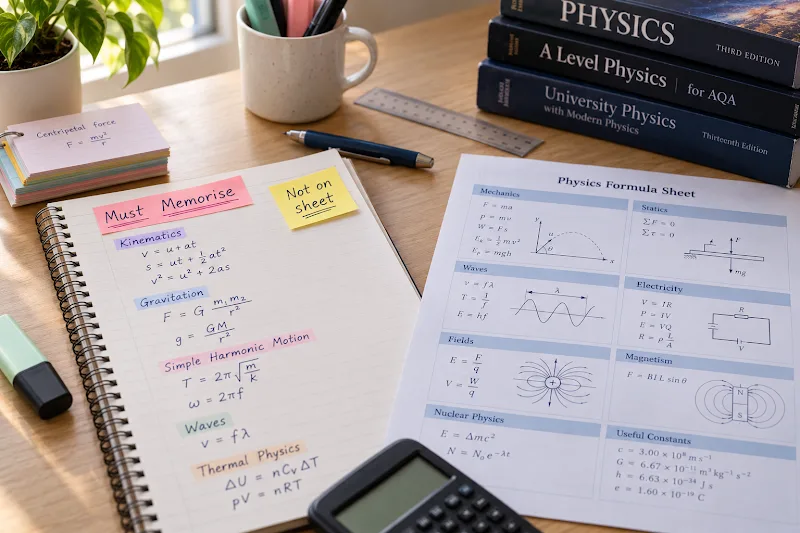
The formulas NOT on the sheet that you must memorise
This is the part most articles skip, and it is where marks are won. Many of the relationships you use most often are not on the Data and Formulae page, because they are considered basic enough to recall. Miss one in the exam and there is nothing to look up.
Here are the ones to drill:
| Topic area | Not given, so memorise |
|---|---|
| Kinematics | v = u + at and s = ½(u + v)t (the other two suvat equations are given) |
| Dynamics and momentum | F = ma; momentum p = mv |
| Energy, work and power | kinetic energy KE = ½mv²; gravitational potential energy GPE = mgh near the Earth’s surface; work W = Fs; power P = W/t and P = Fv |
| Density | ρ = m/V |
| Gases | ideal gas equation pV = nRT |
| Electricity | V = IR; electrical power P = IV |
| Electric fields | Coulomb’s law for the force between two charges, F = Qq/4πε₀r² |
| Waves | wave equation v = fλ |
| Quantum physics | photon energy E = hf |
Look at how ordinary that list is. These are the formulas students use in almost every paper, which is exactly why SEAB leaves them off. The sheet covers the bulky, easy-to-misremember results; the everyday ones are your job.
The lesson: build a personal “must-memorise” list by topic, separate from the sheet, and drill it until it is automatic, especially for Paper 4, where there is no sheet at all. A free downloadable Physics compendium is a good base to start from.
Formulas students think are given but are not
A related trap is the formula that looks standard but is really a special case. Students memorise the special case, assume it is on the sheet, and apply it where it does not hold. Two habits protect you:
- Know the conditions. A formula has a context. The near-Earth gravitational potential energy expression is not the general one. Using the wrong version in the wrong place is a classic lost mark.
- Derive when unsure. If you understand where a result comes from, you can rebuild it under exam pressure instead of guessing.
This is the same reasoning behind why memorising formulas fails without understanding: the sheet rewards students who understand, and quietly punishes students who only memorise.
How to use the sheet well in the exam
- Know the sheet before exam day. Spend time with it during revision so you know what is on it and roughly where. Searching it cold during the paper is slow.
- Decide the physics first, then look up the number. Work out which relationship you need from the concept, then use the sheet to confirm the exact form or pull a constant.
- Do not let it replace working. Marks come from method. Quoting a formula from the sheet is not the same as showing you applied it correctly.
- Pair it with your own memorised list. In Papers 1 to 3, the sheet plus your recall list should cover everything. If a question needs something in neither, that is a signal to re-read the question.
- Prepare for Paper 4 with no sheet. The practical paper has no Data and Formulae page, so rehearse your calculations from memory before exam day.
How MindQuest drills this
We teach students to separate “recall” formulas from “reference” formulas early, then drill the recall list until it is automatic, so the sheet becomes a time-saver rather than a crutch. It is part of the exam-technique step in our five-step Blueprint, taught in our JC H2 and A-Level Physics programme by an ex-MOE JC lecturer.
Want to see how we build the recall list? Book a free trial lesson or grab the free Physics resources to start.
Frequently asked questions
Is the formula sheet given in the A-Level Physics exam? Yes, a List of Formulae and Data is provided. It does not contain every formula you need, so you must still memorise the basics.
What is not on the H2 Physics formula sheet? Common examples are v = u + at, F = ma, p = mv, kinetic and gravitational potential energy, power, V = IR, P = IV, pV = nRT, v = fλ, E = hf and Coulomb’s law. Two of the suvat equations and the resistor combination rules are given.
Do I still need to memorise formulas if the sheet is provided? Yes. Many common relationships are not on the sheet, and the sheet is organised for lookup, so you need to know which formula to use and why before you reach for it.
How should I use the formula sheet during the exam? Work out the physics first, then use the sheet to confirm the exact form or pull a constant. Do not search it cold, and do not let it replace clear working.